
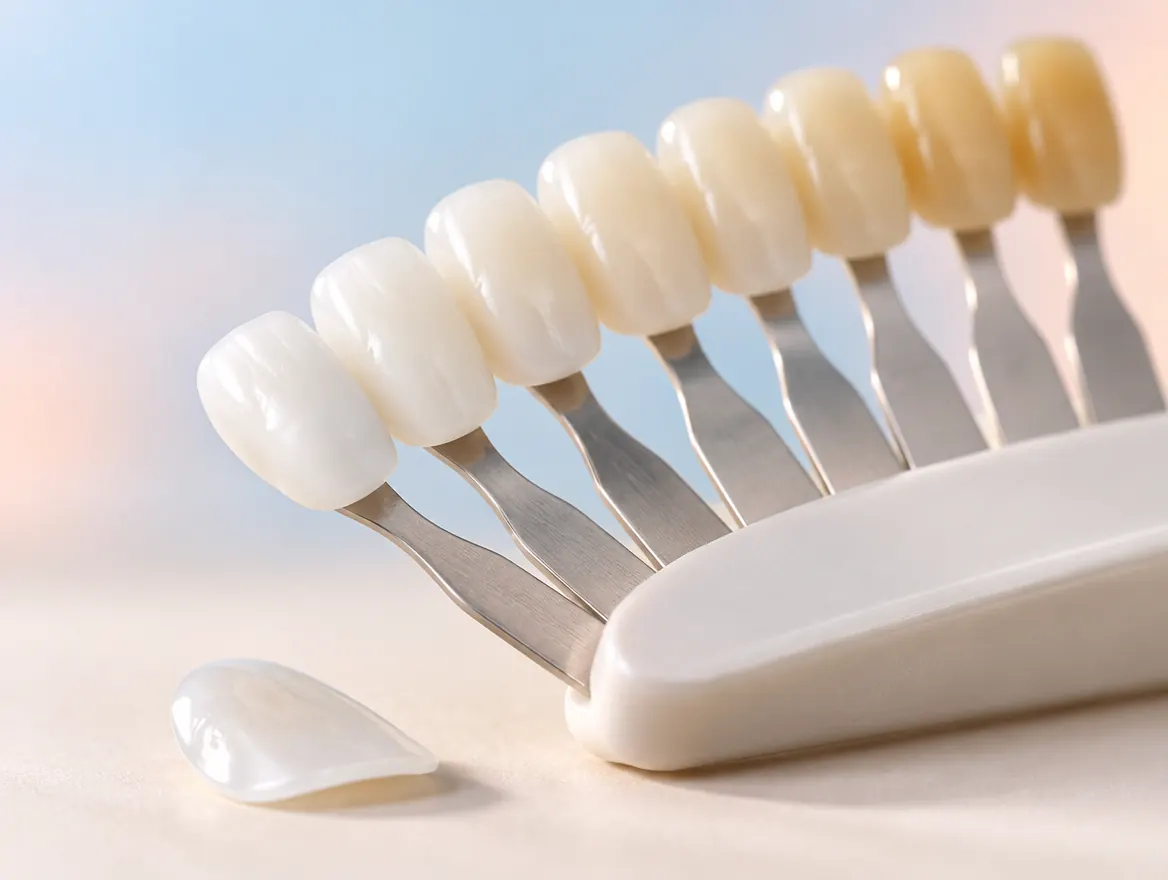
Patients often arrive with the decision made: they want veneers. After the examination it sometimes turns out that a crown is better for some of the teeth. The difference comes down to how much of the tooth needs to be covered.
What the difference is
| Veneer | Crown | |
|---|---|---|
| What it covers | the front of the tooth | the whole tooth |
| Preparation | up to 0.5 mm from the front | from all sides |
| For what kind of tooth | healthy, with minor flaws | badly damaged or root-treated |
| Material | glass ceramic | zirconia or all-ceramic |
When a veneer is enough
A veneer is the choice when the tooth is healthy but the look bothers you: a shade that whitening does not change, a chipped edge, a gap, a slightly rotated tooth. Little is prepared, so most of the tooth stays untouched.
When a crown is needed
- the tooth has a large filling or a large part of it is destroyed by decay
- the tooth has had root canal treatment
- the tooth has changed shade markedly
- the tooth already has an old crown
In these cases a veneer does not have enough healthy surface to bond to. A crown surrounds the tooth on all sides and protects it from fracture.
Can they be combined
They can, and they often are. In the same smile one tooth can receive a crown and the neighbouring teeth veneers. The technician then matches shade and translucency, so the difference cannot be seen.
How the decision is made
The decision is made at the examination, after X-rays and photographs. At the smile trial you see the shape of the future teeth whether they will carry veneers or crowns. More on each solution: porcelain veneers and ceramic crowns.